The BIG interpretation mistake I made & how my mentor showed me “the way”
By the end of this post, you’ll understand:
The big yet very common customer research mistake I made (that most marketers won't admit to)
How seeing beyond the surface of ideal client comments wins you more business
A quick way to gather a lot of voice-of-customer data to dive deep enough into what ideal clients want
Maybe you already have a system for collecting audience feedback or you've done some customer research on your ideal clients.
That's great!
But here’s the ROI-stunting problem hiding behind each sentence of the feedback you’ve collected:
Ideal clients rarely say outright what they mean.
Instead, they often make surface-level comments with hidden meanings.
You already see this when prospects say things like:
"I'll have to think about it more"… when what they mean is "I don't think this is in my budget right now."
"I'll come back in a few months"… when what they mean is "I don't honestly don't know how big of a priority this is for me, I have so much going on in my life right now (that I don't want to bring up on a business call)."
In this post, you’ll see a real-life example of how my business mentor helped me unearth the meaning behind customer research that I collected–that I didn't even know had a deeper meaning at first!
Let’s get into it!
The question I asked to get the feedback I misinterpreted 🤦🏻♀️
"If someone waved a magic wand and I had my ideal business tomorrow, I'd have a business manager on my team to integrate my ideas and my business would easily surpass that $150K-$200K mark."
That's one response I got when I asked the magic wand question in a survey to my ideal clients in 2022.
(Btw, the magic wand question goes like this: "If someone waved a magic wand and you had your ideal life tomorrow, what would that look like?" It helps you understand what your clients want.)
You can read more about what questions to ask in your customer research at these blog posts:
The rookie mistake I made when interpreting ideal client feedback
When I read this response, I made a very rookie mistake—I took it at face value.
Meaning: I saw the words "my business would easily surpass that $150K-$200K mark" and thought…
oh, she just wants her business to surpass $150K-$200K.
Easy conclusion to come to, right?
Obviously, she knows what she needs in business, so this must be an honest answer.
And it IS an honest answer.
But it’s like the part of an iceberg that sticks out from the water. Yes, it’s there. It’s real.
However, there’s a ginormous section of the ice under the surface keeping it afloat.
And missing what was beneath the surface was the mistake I almost made.
Thankfully, business mentor, Betsy Muse, has 30+ years of experience under her belt and set me on the right path. (She’s incredible. If you want to work with her, you can find Betsy here.)
When I showed Betsy the response, she read it and said, "Can you see the overwhelm?"
Um, no, I couldn't (at the time).
What my ideal client was actually saying—aka, the meaning behind her words
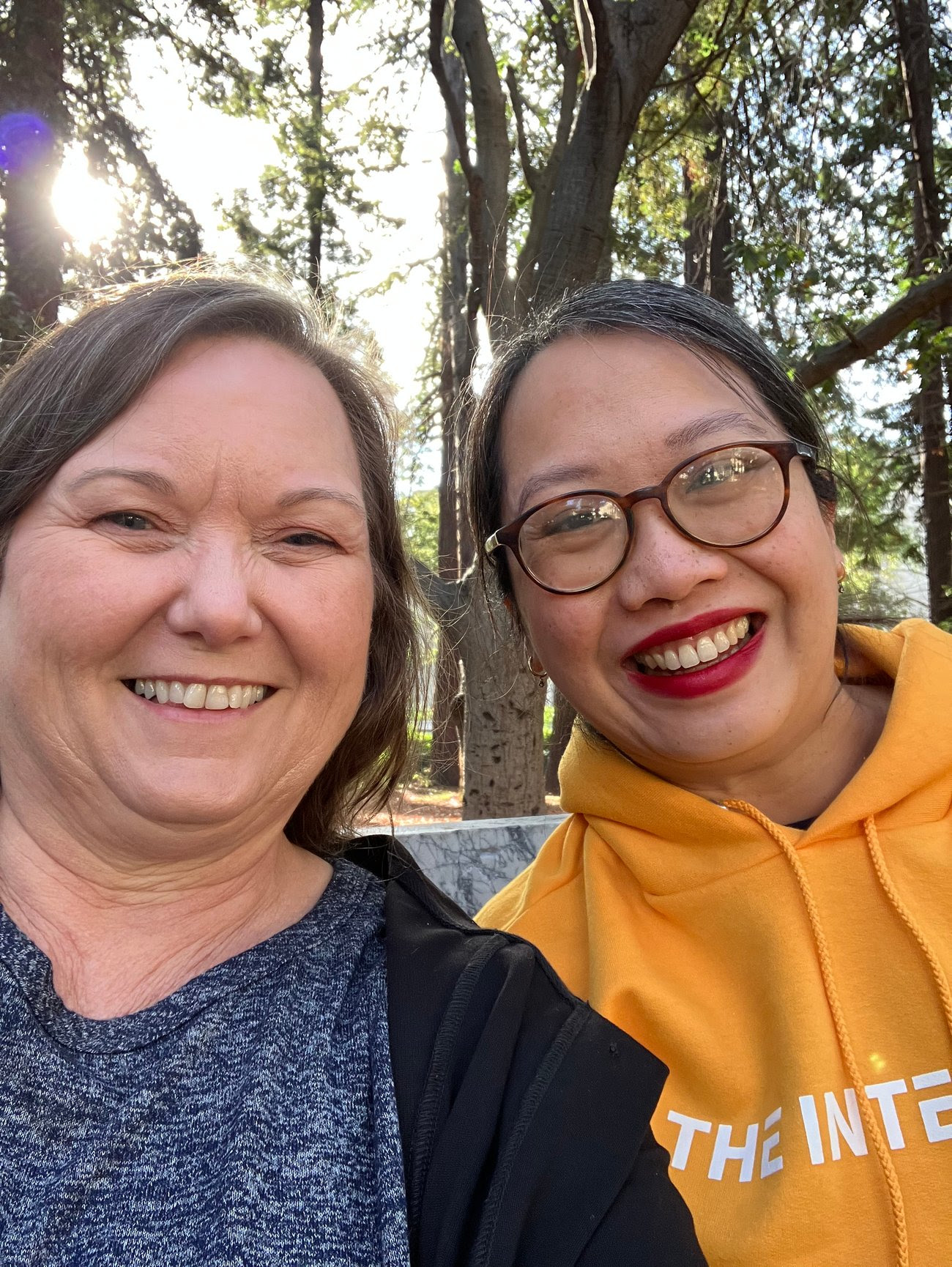
Betsy & me
Here's how Betsy saw the situation:
The respondent had already indicated on my survey that she made $75K-$150K.
For someone to make that much, they have to have systems in place, from lead gen to fulfilling client work.
If that's your starting point and you add a business manager to help you implement even more, the next logical milestone in your business would not be going from $150K to $200K. (Those numbers are within the same range when you account for the cost of the business manager.)
The next milestone would be more like $500K.
The fact that the respondent couldn't see that–the fact that the horizon she could see stretched very little in front of her–was what Betsy read as overwhelm.
Overwhelm was her first real problem, not her lack of a business manager.
How I confirmed the below-the-surface meaning of my ideal client’s words
This respondent indicated on my survey that she was open to an interview so I followed up with her and confirmed her overwhelm (which she was very impressed by and grateful for).
Success!
Now, more importantly…
Here’s what you can do so you never misinterpret your customer research
The reason I shared the above story with you is to illustrate how your ideal clients don't always know what they want–even when you ask them directly, as with the magic wand question.
That's why it's so important to cross-check your data—the more data you have, the less likely you are to fall into interpretation mishaps. (Remember the iceberg analogy above? It’s about getting enough of the iceberg so you know what’s happening under the water.)
While surveys and interviews are great for collecting customer research, they’re time consuming. Whether you’re just starting out or you want to update to what your ideal clients are saying about offers like yours, an easier way to gather voice-of-customer data is review mining. Review mining is another copywriter research technique that gets you a lot of info about your customers all at once so you have a better idea of the full iceberg from the get go.
I show you how to do review mining and turn it into money-making messages in my Messaging That Converts Workshop.
By the end of the workshop, you’ll understand:
→ How to find out how your ideal clients see their problems
→ The solution they think will solve their problems so you can position yourself accordingly
→ What they’ve already tried (to no avail) and what they desperately want that no one's offered them yet
In 90 minutes, you’ll understand how to gather a high volume of customer research at once… and how to turn that info into messages that bring in the right clients.
All for $27, too!
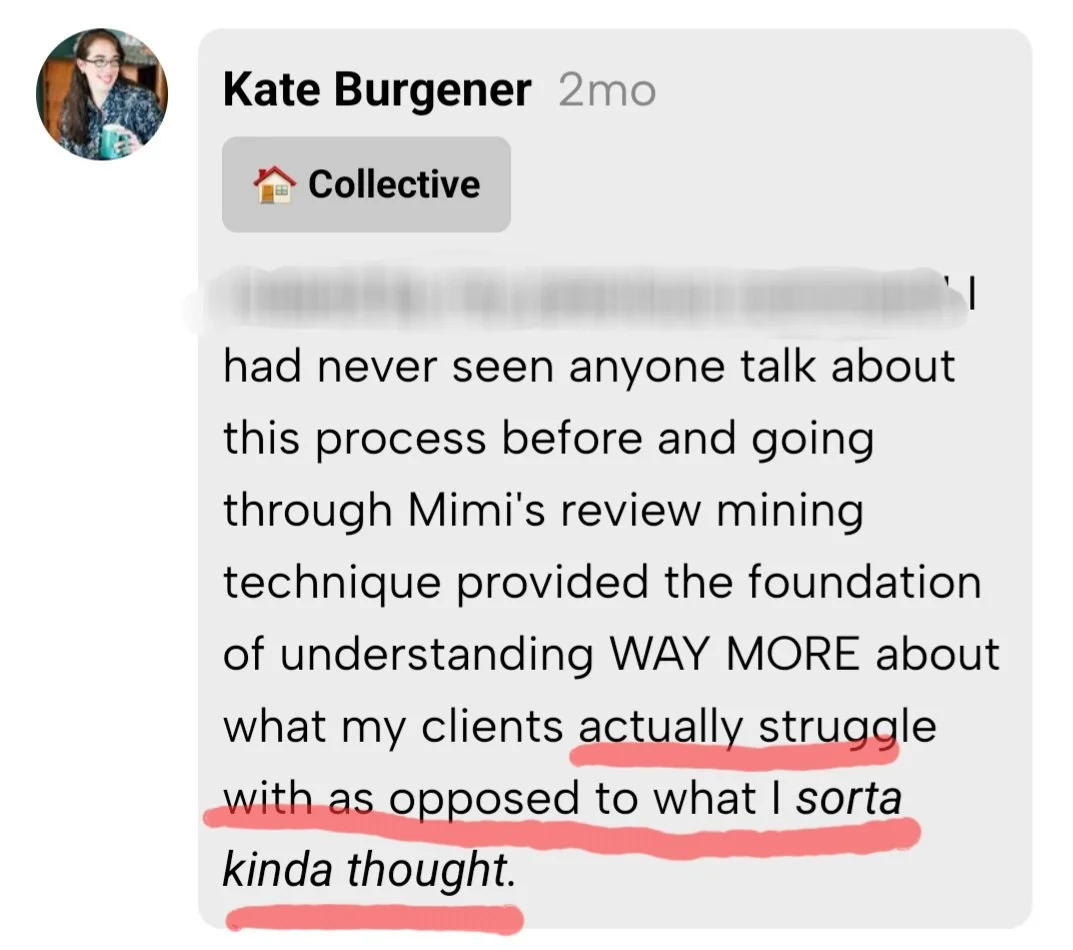
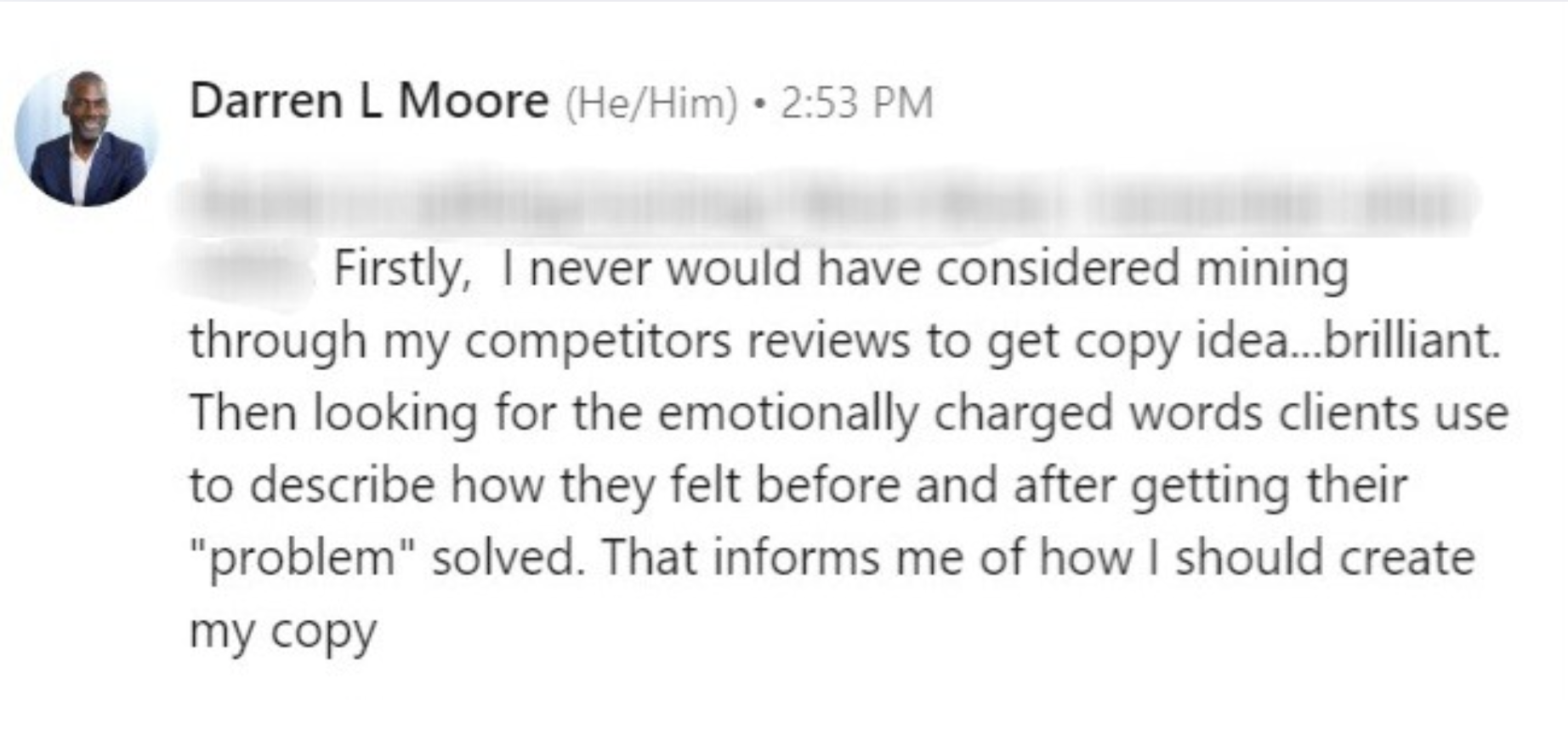
Stop guessing what your clients struggle with
Like these happy participants did
Get the Messaging That Converts Workshop to quickly find out what your ideal clients already want to pay you for—and how to turn that info into messages that sell.