By the end of this post, you’ll know:
What market sophistication is and how to identify your audience’s level of sophistication
How to speak directly to that segment of your audience
How to improve your marketing TODAY with this knowledge

If you’re looking to speak directly to the clients who won't hesitate to hire you, this post is for you.
In this post, you’ll discover how to easily identify what your audience knows about you and what you do.
I’ll show you how the spammers who pop up in your DMs and Marie Forleo will help you determine how to speak to the right audience TODAY!
How spammers in your DMs reveal your market sophistication level
Here’s a situation we’ve all been in before:
A friend request lands in your Facebook notifications.
You check out the requester’s profile and see they’re a fellow business owner.
You’ve got mutual friends so you hit “accept.”
So far, so good.
However…the next thing you know, they send you a DM. Which is when you roll your eyes. 🙄
Because the message is one you’ve seen a hundred times before–you know they want you to respond so that they can pitch their services exactly two more messages down the line.
Not worth bothering with, you think.
You quickly type your canned response for such things and move on–thank you, next.
***
Shoutout to the DM’ers for this story!
I don’t love your DMs, I doubt they’re effective as a conversion strategy, but I admire your hustle and I understand that you’re just trying to put better shoes on your kids’ feet, like myself and many of us out here.
Anyway.
Let’s talk about why I’m bringing the DM’ers up, which I’ll summarize in two words:
Market sophistication.
Market sophistication is the reason we peace out when we get spammy DMs.
Market sophistication refers to how familiar your audience is with you, your offers, and your promises.
And in a world where we’re getting waaay too many impersonal, canned DMs with unrealistic promises, the market sophistication for such things is high.
Very high.
So in honor of the DM’ers and their unsolicited messages, here is a piece of unsolicited advice from me to them. ⬇️
For more conversions, calibrate your copy to your market’s sophistication level
Next time you write your copy, ask yourself this:
On a scale of 1-10, how much exposure has your audience had to offers similar to yours?
Market sophistication is about figuring out where your audience lands on that scale–because that changes how you write your copy.
You’d talk differently to someone lower on that scale versus someone higher on it.
Let’s break it down—think about your audience and choose the sophistication level that best corresponds to how familiar they are with your offers:
1) An audience with lower sophistication
This audience is new to offers like yours.
They’re learning about your offers, what they are, and why they need them. They haven’t seen others in your field yet so the promises you make are new to them–and more believable.
(Let me say now--there's nothing wrong with an audience that's lower in sophistication. As we'll see below, Marie Forleo’s B-School is for a lower sophistication audience and it pulls in impressive numbers. (Lower sophistication just means less exposure to offers like yours.)
2) An audience with medium sophistication
This audience has seen offers similar to yours.
They have a way to categorize your offer–but they haven’t seen it all. They are not so new that they’ll believe just any promise but because they haven’t been inundated with similar offers, it may be easier for them to believe your solution can work for them.
3) An audience with high sophistication
This audienceis very familiar with your offer.
This group has seen it all–and is more skeptical. They may even have experienced an offer similar to yours in the past to have it fall short, making them less likely to believe promised results.
Forward &
save this post!
If you have a business friend who could benefit from understanding market sophistication levels, forward this post to them!
And don’t forget to bookmark this post or save it somewhere so you can refer back to it!

“So Mimi, what level of sophistication is the easiest to sell my offers to?”
I've seen marketers boldly proclaim it’s easier to sell to audiences with lower sophistication–but I disagree with that.
Selling to any group takes a combo of research, messaging, positioning, and marketing, all personalized for that group.
None of it is “easy.”
But knowing where your audience lands on the scale of sophistication does make it easier–because it shows you how to talk to them.
Let me show you what I mean. ⬇️
Example deep dive: Marie Forleo business coaching edition
Let’s take a look at something we’re all familiar with, Marie Forleo’s B-School.
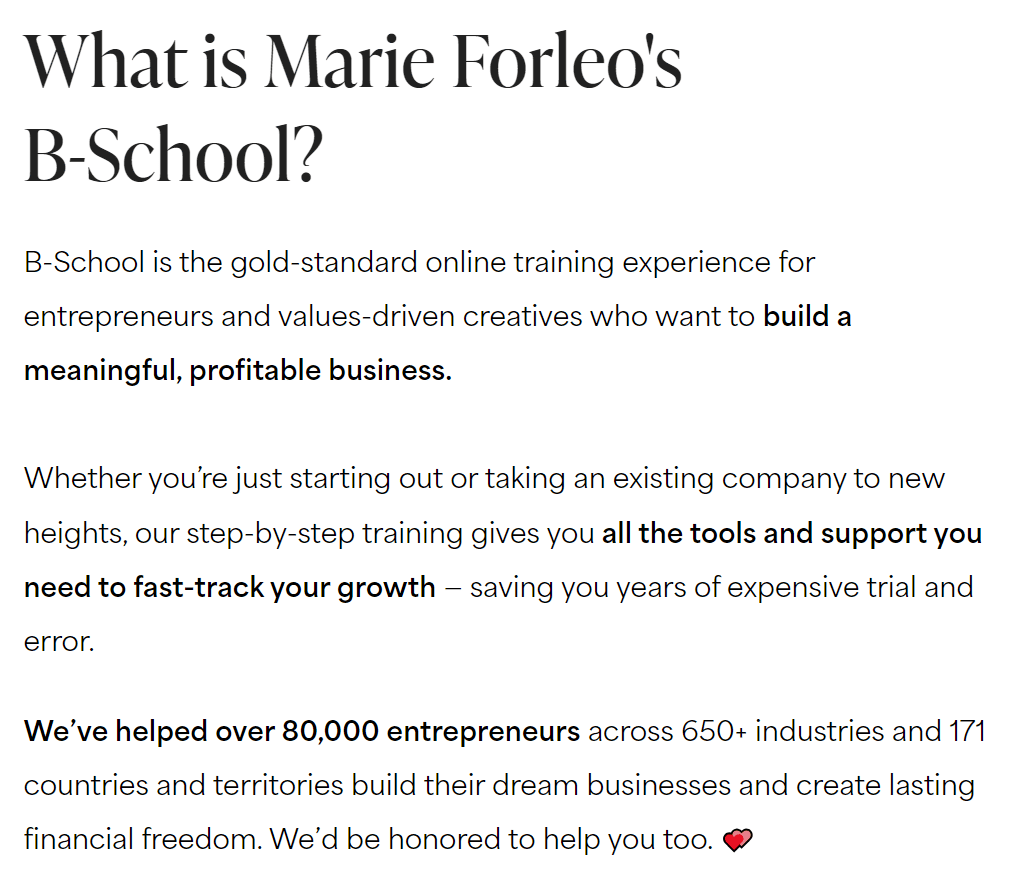
This copy is pulled from the current B-School page–take a look:
Who exactly is Marie Forleo talking to?
In terms of sophistication level, I'd say this is written for a low, maaaybe medium-sophistication audience, which is what B-School is for--folks who don't have a business and are thinking of starting one or folks who are early enough in their business that this is one of the first investments they're considering.
I think a fantastic takeaway from watching how Marie markets B-School is the power of knowing your audience's sophistication level.
For a lower sophistication audience, this copy has everything they want to hear--peep what she's bolded: the promises of getting to do something more meaningful than corporate work, of getting all the tools to go from a cubicle to working anywhere in the world, the impressive stats.
That's why B-School converts so well--it reaches a large number of low-sophistication folks and gives them what they want to see on the page.
Who is B-School NOT talking to?
Now, for a higher sophistication audience, this copy won't work.
Someone who's experienced knows just a few words in that “gold-standard” doesn't mean anything unless it can be proven. (“Gold-standard” by whose standards, exactly?)
Someone who's experienced knows that “getting all the tools” isn't as one-and-done as it sounds--because the tools that work for one business might not work for another.
(And tools are always updating anyway, periodically forcing everyone into choosing different tools.)
Someone who's experienced will understand that it's worth it to make investments that save trial and error--but also that some trial and error is inevitable.
And that nothing beats steady, sustainable growth.
Finally, someone who's experienced would be more skeptical of the large numbers.
How many of those success stories happened because folks were working at their business for a decade before joining B-School?
How many of them had other advantages that propelled their businesses? How many of them are even still in business today?
These questions bring me to my final point. ⬇️
Knowing your audience’s sophistication level will instantly improve your marketing
To increase your chances of conversion, know your audience's sophistication level.
In both the DM example and B-School example, we see how they might work for an audience that isn't familiar with those offers...
and how they definitely don't work for an audience that's seen it all.
Let me be clear: There's nothing wrong with the fact that spammy DMs and B-School are for a lower sophistication audience.
(Though spammy DMs convert abysmally so there is something wrong with that approach--but there's nothing wrong with being for a lower sophistication audience.)
To do marketing well, you just need to know your audience's sophistication level so you know what offers to present and how to do so.
So, my friend, next time before you write your copy, ask yourself this:
On a scale of 1-10, how much exposure has your audience had to offers similar to yours?
Watch how that changes what you write.
Until next time,
Mimi
PS. This post is for a highly sophisticated audience.
That's you!
I know you have many marketing blogs to choose from to consume info, and I don't take it lightly that you chose mine.
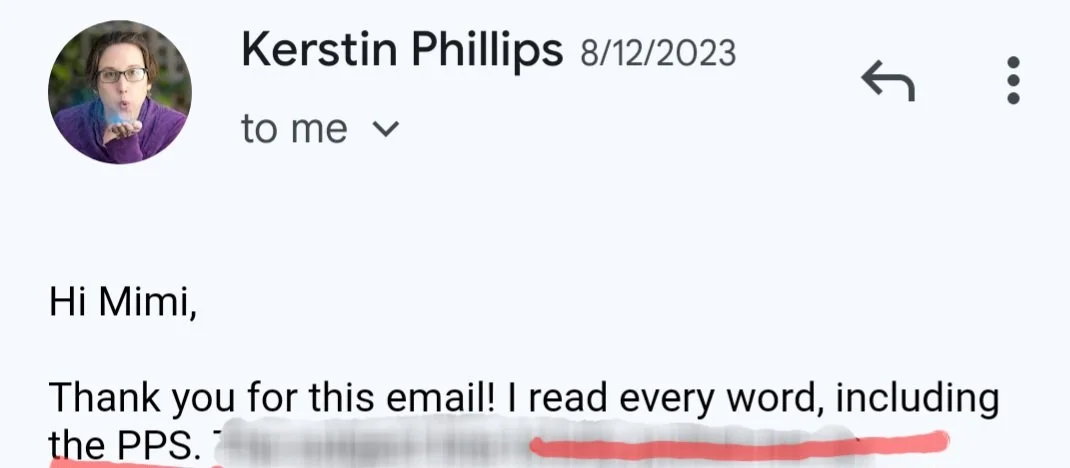
PPS. One of the kind notes I get is about how folks read through my PS section here.
(See proof —>)
Firstly, thank you for reading all the way down to the bottom!
Secondly, the reason this section varies each time is because I know you're highly sophisticated.
See, when I read content that has the same copy at the bottom each time, I glaze over that info. I might read it the first time because I'm lower on the sophistication scale then... but if I see a few emails with the same info, my sophistication level increases.
By the time I'm a high sophistication reader, I know what I'm going to see. So why would I read it?
Take this into consideration next time you're writing your PS section, friend. There's nothing like knowing your audience's sophistication level.
If you’d like my research-driven,
conversion-focused eyes on your copy…

The easiest ways for us to get started are:
💥 The Small Start, Big Wins™ Copy Polish, where I optimize your webpages for sales
💥 The Quick Clicks Email Polish, where I optimize your emails for opens and engagements
💥 The Messaging Playbook, where I hone in on messaging that attracts the right clients
Here’s what clients have said about our work together in my Small Start, Big Win™ packages:


Questions? Want to chat?