Give your prospects what they want according to survey numbers—not what you think they want
By the end of this post, you’ll know:
How your own unconscious bias can cost you significant profits
How to attract your ideal client using a simple survey
What questions to ask in a survey and who to ask
Does it feel like your website and social media just don't work?
Like you're posting into the void?
Or worse… attracting the wrong prospects?
When it comes to client attraction, surveys help you discover why your marketing isn’t working and what to say instead.
Here's how I found out for myself how surveys give your marketing direction:
If you’d asked me when I started my business what I thought was one of the MOST important things to my clients, I would have rattled off my answer (being in business for a larger mission) right away--
but it would have been wrong.
Dead wrong!
That was because early in my copywriting career, I ran a survey that shook the foundation of what I knew about my audience.
I asked my ideal audience members what their biggest business problem was.
And my own bias was revealed to me when the results came in—it was big wake-up call.
Because, while being mission-driven DID come up in the survey answers, it wasn't at the top of the list.
The biggest problems my audience described?
They were around marketing—specifically, they were around client attraction for higher-priced offers.
Since I ran this survey, I was able to focus all my copy (website, blog, social media) on selling premium offers (easier to do with premium copy working for you!)... and focus a little less on missions.
(By the way--it's worth noting that if I asked my ideal audience whether missions were important to them, I do believe everyone would say yes. But the danger of asking a yes/no question is that it would blind me to other factors that are also important--in this case, good marketing.)
You MIGHT be right about what your clients want… but being wrong is too expensive to take the risk. Run a survey to check!
The biggest lesson I learned from my survey was that surveys check your own bias. (And we all have biases—we’re all susceptible to making assumptions about our audience.)
This is backed up by fact: Cognitive bias is a known phenomenon that can be costly to businesses of all sizes. According to this study by the International Journal of Multidisciplinary Research and Growth Evaluation, “data-driven decision-making helps avoid falling into the overconfidence trap, a common cognitive bias where individuals tend to overestimate their knowledge and abilities.”
Meaning: You don't want to assume something's important to your audience without the data to back it up… because data doesn’t lie.
3 groups you can survey to help your marketing convert prospects into paying customers
Here are three groups you can run surveys on to collect unbiased data to direction your marketing:
1) You can survey your ideal audience like I did--hugely useful to know what they wanted so I could structure my offers, website, and even my Smarter Customer Research newsletter around them.
2) You can survey current clients--maybe you think everything’s going well in, say, your group program but there could be something bothering clients that no one’s brought up. A survey is an easy, time-effective way to bring this out so you can make sure to give your clients what they want.
3) You can survey past clients--this is extremely useful to get a more honest idea of what they felt went well and what they felt could be improved in their experience with you. A survey also negates the risk for bias that interviews incur because usually folks who agree to an interview have had great experiences--but you want to know what fell a little flat too so you can adjust your offers and delivery.
Note that in all cases, I'd run these surveys anonymously because people are more likely to answer honestly that way (and you 100% want to know the truth, even if it’s uncomfortable to hear at first—it only benefits your business). You can always have an option at the end of a survey for someone to leave their name and email for further follow up.
Stop guessing what your
ideal clients will pay you for
I talk more about surveys and other topics related to customer research in my newsletter, Smarter Customer Research.
Sign up to understand how to do smart customer research and translate it into conversion copy!
What should you ask to get the best results from your survey?
This is an unpopular thing to say, but…
it depends!
It depends on the information you want to gather.
So no one can script a survey for you.
However, here's a look at the questions I asked in my survey and why I asked them. I hope having this info gives you an idea of how to create your own survey:
Question No. 1: Start with a goal in mind
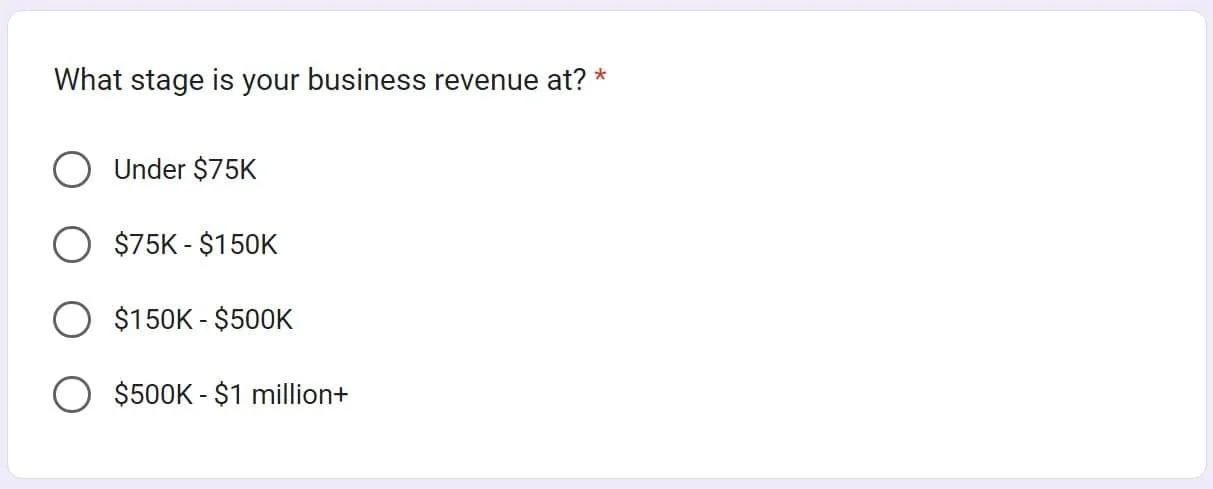
The goal of my survey was to identify the biggest problem among my target audience, coaches and creative service providers with income of $75+K.
Generally speaking, this is the income level that my services provide for--and if you're not there yet please know I'm sharing this with no judgement, we've all been at the starting line.
(Additionally, while my paid offers start at $1197, I share information for free on my blog and my newsletter so those are also options I provide folks with.)
Because I drew a line with income, my first question addressed this:
Question No. 2: Don’t give any options–make them ramble
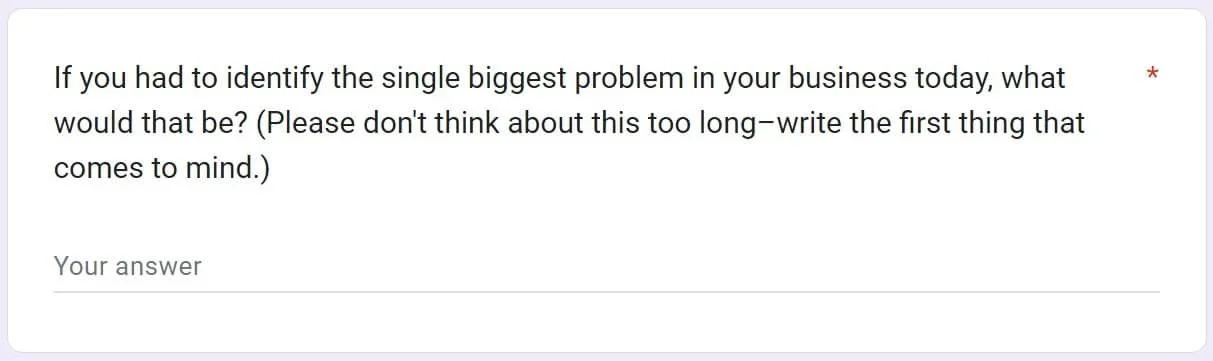
My second question addressed what I really want to know in people's own words--their biggest problem in business:
Question No.3: Ask them the “miracle question”
Next, I continued to ask why their answer to the previous question is their biggest problem. So far, I'm getting information about their pains.
But I also wanted to know what their dreams are--everyone has a pain state and dream state--so the last required question is the "miracle question":
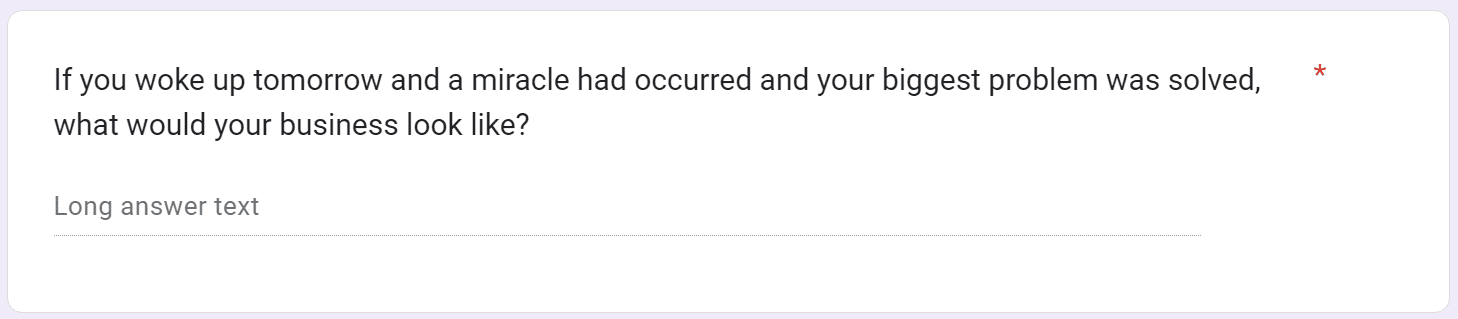
The "miracle question" gives people an opportunity to share what they really want. It’s one of the most informative survey questions you can ask because it allows you to shape what you’re offering as the solution they’re already seeking—and willing to pay for.
What do you do with the information you discover in your survey?
After parsing the info I'd gathered into usable data, I created my offers around what people in my ideal audience range wanted. (Client attraction in the form of conversion-focused websites.)
You can do the same with your survey responses--once you count up the most popular replies, you can make your business decisions based on them.
For me, because I knew marketing was the most important thing, a lot of my homepage became about conversion-focused marketing.
And I get it, who doesn't like sales?!
(Homepage is here for you to check out btw.)
Like I said above, the mission-driven stuff still appears but because my data told me it was less important, it appears far lower on the page.
It's only until you scroll down to the "Get yourself a copywriter who cares about your business as much as you do" that you see I mention my experience with underrepresented populations (as my mission is working with people who have felt underrepresented).
Bottom line: surveys don’t lie. Use them to make unbiased business decisions around attracting and retaining customers.
Bias is incredibly easy to incur—so easy that the American Marketing Association writes:
“It is well established that marketers tend to project their own preferences onto target consumers’ preferences regarding new products or features. This phenomenon is referred to as the ‘false consensus effect,’ which is one of the most prevalent biases studied in psychology.”
Because human bias is something we all project, you want to give your people what they actually want according to survey numbers--not what you think they want.
Whether you survey prospects, clients, or past clients, doing so is a great way to get feedback from them so you can make fact-based business decisions (rather than decisions based on your assumptions).
Of course, your assumptions may very well turn out to be true too…but in that case, the data should prove that before you make decisions that could be costly.
If you’d like my research-driven,
conversion-focused eyes on your copy…

The easiest ways for us to get started are:
💥 The Small Start, Big Wins™ Copy Polish, where I optimize your webpages for sales
💥 The Quick Clicks Email Polish, where I optimize your emails for opens and engagements
💥 The Messaging Playbook, where I hone in on messaging that attracts the right clients
Here’s what clients have said about our work together in my Small Start, Big Win™ packages:


Questions? Want to chat?